

Faculty Research Profile

KYUJIN KWAK


학력
2007: PhD, Computational Astrophysics, State University of New York at Stony Brook (Stony Brook University)
1999: MS, Theoretical Nuclear Physics, Seoul National University
1997: BS, Physics, Seoul National University
주요 경력
2021-Present: Associate Professor, UNIST
2012-2020: Assistant Professor, UNIST
2012: Post-doc., Korea Astronomy and Space Science Institute (KASI)
2007-2012: Post-doc., University of Georgia
수상/학회/외부활동
2020-Present: 운영위원, 한국중성미자관측소 추진단
2020-Present: Member, Hyper-Kamiokande Collaboration
2018-Present: Member, KAGRA Collaboration
2013-Present: Member, Korean Astronomical Society
2012-Present: Member, Korean Physical Society
2004-Present: Member, American Astronomical Society
전산천체물리학 연구실
Computational Astrophysics Laboratory
우리 연구실은 전산/이론 천체물리학 연구를 수행하고 있습니다. 천체에서 발생하는 원자핵반응, 이온화반응, 분자반응을 컴퓨터 시뮬레이션으로 구현하고 그 결과를 관측과 비교하는 연구입니다. 이러한 연구를 통해 관측된 천체현상의 이면에 존재하는 "왜"와 "어떻게"를 이해할 수 있습니다.
최근 들어 비전자기파 천문학 혹은 다중신호 천문학 연구에도 관심을 갖고 이 분야 연구도 수행하고 있습니다. 현재 가동중이거나 장차 가동될 중력파 및 중성미자 망원경에서 관측될 수 있는 천체 현상을 이론적으로 예측하는 연구입니다. 새로운 이론 연구는 인공지능 혹은 기계학습을 활용한 연구도 포함하고 있습니다.
Various reactions occur in the Universe. Nuclear reactions occur inside stars and on the surface of compact objects like white dwarfs and neutron stars. Ionization of atoms (and recombination of electrons) occur in any plasma state and even chemical reactions are important in cool, dense gas which will form stars eventually. We are interested in simulating these reactions in the relevant astrophysical environments. Our simulation results are compared with observations and give a hint on how we can understand what we see/observe.
We also have interest in multi-messenger astronomy (MMA), an emerging field in modern astronomy. MMA includes gravitational wave (GW) astronomy, neutrino astronomy (NA), and conventional electromagnetic wave (i.e., light) astronomy. We are participating in two MMA international collaboration, KAGRA (Japaneses GW detector) and Hyper-Kamiokande (Japanese NA detector). Our research activities focus on predicting unpredicted astrophysical sources that could be discovered with current and future GW and NA detectors.
Various reactions occur in the Universe. Nuclear reactions occur inside stars and on the surface of compact objects like white dwarfs and neutron stars. Ionization of atoms (and recombination of electrons) occur in any plasma state and even chemical reactions are important in cool, dense gas which will form stars eventually. We are interested in simulating these reactions in the relevant astrophysical environments. Our simulation results are compared with observations and give a hint on how we can understand what we see/observe.
We also have interest in multi-messenger astronomy (MMA), an emerging field in modern astronomy. MMA includes gravitational wave (GW) astronomy, neutrino astronomy (NA), and conventional electromagnetic wave (i.e., light) astronomy. We are participating in two MMA international collaboration, KAGRA (Japaneses GW detector) and Hyper-Kamiokande (Japanese NA detector). Our research activities focus on predicting unpredicted astrophysical sources that could be discovered with current and future GW and NA detectors.
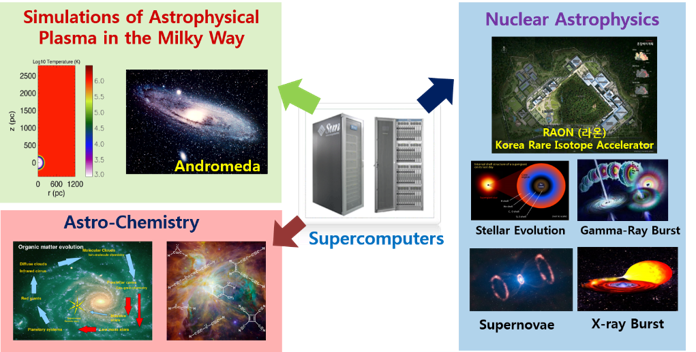
연구분야
핵천체물리학, 성간물질, 천체화학, 고성능컴퓨팅 / Nuclear astrophysics, interstellar medium, astro-chemistry, supercomputing
Nuclear astrophysics, interstellar medium, astro-chemistry, supercomputing
연구 희망분야
중력파, 중성미자 천문학, 인공지능(기계학습) / Gravitational wave, neutrino astrophysics, machine learning
Gravitational wave, neutrino astrophysics, machine learning
연구주제
비평형 과정을 포함한 유체역학 시뮬레이션
상대론적 현상을 구현하는 유체역학 시뮬레이션
원자핵반응, 이온화반응, 분자반응을 포함한 유체역학 시뮬레이션
빛을 포함한 유체역학 시뮬레이션
중력파 및 중성미자 천체물리학: 새로운 천체현상 탐구
인공지능, 빅데이터, 기계학습을 활용한 천체물리학 연구
Hydrodynamic Simulations of Astrophysical Phenomena at Non-equilibrium States
Numerical Relativity: Hydrodynamic and Magneto-Hydrodynamic Simulations of Relativistic Flows
Computational Nuclear Astrophysics for the Rare Isotope Accelerator Experiments
Relativistic Radiative Transfer for the Astrophysical Applications (e.g., Gamma-Ray Bursts and Active Galactic Nuclei)
Numerical Astro-Chemistry
Gravitational Wave and Neutrino Astrophysics
Hydrodynamic Simulations of Astrophysical Phenomena at Non-equilibrium States
Numerical Relativity: Hydrodynamic and Magneto-Hydrodynamic Simulations of Relativistic Flows
Computational Nuclear Astrophysics for the Rare Isotope Accelerator Experiments
Relativistic Radiative Transfer for the Astrophysical Applications (e.g., Gamma-Ray Bursts and Active Galactic Nuclei)
Numerical Astro-Chemistry
Gravitational Wave and Neutrino Astrophysics
국가연구개발사업 기술 분류체계
국가과학기술표준분류
ND. 지구과학(지구/대기/해양/천문) > ND12. 천문학 > ND1207. 고에너지천문학
논문
1. "Isotopic Compositions of Ruthenium Predicted from the NuGrid Project", Seonho Kim, Kwang Hyun Sung, and Kyujin Kwak, Astrophysical Journal, 924, 88 (2022)
2. "Measuring the masses and radii of neutron stars in low-mass X-ray binaries: Effects of the atmospheric composition and touchdown radius", Myungkuk Kim, Young-Min Kim, Kwang Hyun Sung, Chang-Hwan Lee, and Kyujin Kwak, Astronomy and Astrophysics, 650, A139 (2021)
3. "Tidal deformability of neutron stars with realistic nuclear energy density functionals", Young-Min Kim, Yeunhwan Lim, Kyujin Kwak, Chang Ho Hyun, and Chang-Hwan Lee, Physical Review C, 98, 065805 (2018)