

Faculty Research Profile

Young-Bin Park


학력
2003 - 2004: Postdoctoral Fellow, Georgia Tech
2003: Ph.D. in Mechanical Engineering, Georgia Tech
1997: M.S. in Mechanical Design and Production Engineering, Seoul National University
1995: B.S. in Mechanical Design and Production Engineering, Seoul National University
주요 경력
2009 - Present: Assist./Assoc./Full Professor, UNIST
2007 - 2008: Research Scientist, Emitech, USA
2004 - 2007: Assistant Professor, Florida A&M University, USA
1997 - 1999: Research Engineer, Hyundai Motor Company
수상/학회/외부활동
Faculty of the Year Award, UNIST (2017)
Academic Achievement Award, Korean Society for Composite Materials (2015)
Best Teaching Award, UNIST (2013, 2016)
City of Ulsan Mayor Commendation, 5th Ulsan Automotive Day (2011)
Best Paper/Poster Awards : SPE ANTEC, ACCM, AMSM, Korean Society for Composite Materials, Korean Society for Precision Engineering, Korean Society of Mechanical Engineers, Korea Carbon Society, etc.
기능성 지능형 재료연구실
Functional Intelligent Materials Lab (FIMLab)
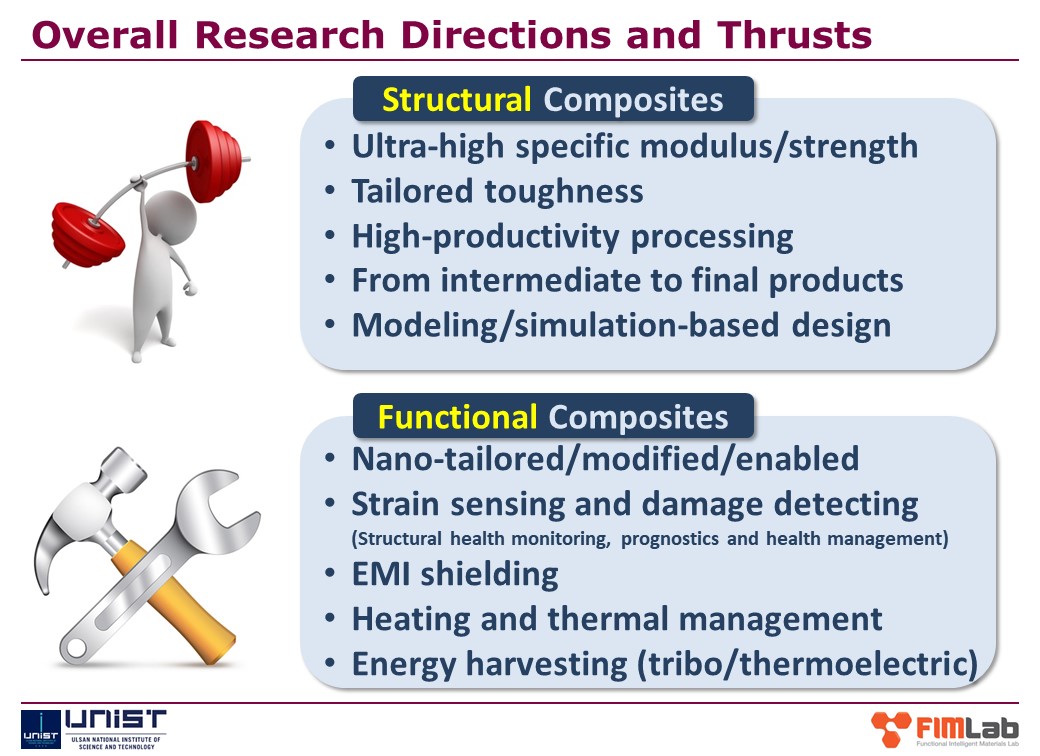
인간은 몸에 분포되어 있는 신경망을 통해서 통증을 느낄 때, 치료를 받거나 병원을 찾습니다. 소재나 구조물에도 이러한 “신경망"을 부여하면, 외부 환경 뿐만 아니라, 변형, 파손과 같은 내부 상태를 감지할 수 있게 됩니다. FIMLab에서는, 2개 이상의 소재를 혼합하고 (복합재료), 소재 시스템을 구조적으로 설계함으로써 (“Material Systems by Design”), 구조건전성 자가센싱과 같은 스마트한 기능을 갖는 소재 및 구조물 연구를 수행하고 있습니다. 뿐만 아니라, 무거운 금속을 대체할 수 있는 경량 복합재료 제조 및 설계 연구도 수행하고 있습니다.
Dr. Park’s research interests are in the field of advanced composite and nanocomposite technologies for development of functional and intelligent materials and structures, that is, materials that “think” and “respond.” In particular, his research focus is on the application of high-performance nanoscale materials, especially graphene and carbon nanotubes, to multifunctional composites and structures. An example would be a “smart” automotive vehicle or aircraft that can self-sense its structural health, protect itself from external disturbances or hazards, and ultimately self-adjust or take necessary measures with minimal human intervention. More recently, Dr. Park has expanded his scope of research into novel technologies for rapid, affordable manufacturing of fiber-reinforced composites, particularly targeted for automotive industry. Currently, Dr. Park is serving as the director of the UNIST Composites Research Center in collaboration with Fraunhofer ICT.
Dr. Park’s research interests are in the field of advanced composite and nanocomposite technologies for development of functional and intelligent materials and structures, that is, materials that “think” and “respond.” In particular, his research focus is on the application of high-performance nanoscale materials, especially graphene and carbon nanotubes, to multifunctional composites and structures. An example would be a “smart” automotive vehicle or aircraft that can self-sense its structural health, protect itself from external disturbances or hazards, and ultimately self-adjust or take necessary measures with minimal human intervention. More recently, Dr. Park has expanded his scope of research into novel technologies for rapid, affordable manufacturing of fiber-reinforced composites, particularly targeted for automotive industry. Currently, Dr. Park is serving as the director of the UNIST Composites Research Center in collaboration with Fraunhofer ICT.
연구분야
Composite Materials Nanocomposites Smart Materials and Structures Innovative Automotive Composites
Composite Materials Nanocomposites Smart Materials and Structures Innovative Automotive Composites
연구 희망분야
Lightweight Composites for Green/Smart Mobility, Structural Health Monitoring (SHM) and AI-based Prognostics and Health Management (AI-PHM)
Lightweight Composites for Green/Smart Mobility, Structural Health Monitoring (SHM) and AI-based Prognostics and Health Management (AI-PHM)
연구주제
1. 복합재 압저항 거동 기반 변형/촉각 감지 및 구조 상태 모니터링 / Piezoresistive composite based strain/tactile sensing and structural health monitoring
2. 고장 예지 및 수명 관리를 위한 자감지 탄소섬유 복합재 (머신 러닝) / Self-sensing carbon fiber composites for prognostics and health management (machine learning)
3. 탄소나노소재(그래핀, CNT)와 보강섬유를 포함하는 멀티스케일 하이브리드 복합재 / Multiscale hybrid composites containing carbon nanomaterials (graphene, CNT) and fiber reinforcement
4. 경량 자동차 및 항공우주용 섬유강화 및 하이브리드 복합재 설계 및 제조 (고속성형) / Design and rapid manufacturing of fiber-reinforced and hybrid composites for automotive and aerospace
5. CFRP 기반 마찰 발전 및 에너지 하베스팅 / CFRP-based triboelectric generation (energy harvesting)
Piezoresistive composite based strain/tactile sensing and structural health monitoring
Self-sensing carbon fiber composites for prognostics and health management (machine learning)
Multiscale hybrid composites containing carbon nanomaterials (graphene, CNT) and fiber reinforcement
Design and rapid manufacturing of fiber-reinforced and hybrid composites for automotive and aerospace
CFRP-based triboelectric generation (energy harvesting)
국가연구개발사업 기술 분류체계
국가과학기술표준분류
EC. 화공 > EC03. 고분자공정기술 > EC0306. 복합재료 제조공정기술
논문
1. I. Y. Lee, H. D. Roh, S. Y. Oh, Y.-B. Park, “Advanced condition-based self-monitoring of composites damaged area under multiple impacts using Monte Carlo based prognostics,” Polymer Testing, 123, 108024, 2023.
2. I. Y. Lee, C. Joung, S. Y. Oh, Y.-B. Park, “Real-time in-depth damage identification and health index system for carbon fiber-reinforced composites using electromechanical behavior and data processing tools,” Composites Science and Technology, 236, 109951, 2023.
3. I. Y. Lee, J. Jang, Y.-B. Park, “Advanced structural health monitoring in carbon fiber-reinforced plastic using real-time self-sensing data and convolutional neural network architectures,” Materials & Design, 224, 111348, 2022.
4. G.-H. Kang, C. Joung, H.-G. Kim, S. Im, S.-C. Kang, W. Ji, Y.-B. Park, “Manufacturing, thermoforming, and recycling of glass fiber/PET/PET foam sandwich composites: DOE analysis of recycled materials”, Polymer Composites, 43(10), pp. 8807-8817, 2022.
특허
1. 10-2145246, Composite PHM with piezoresistivity (전기저항 변화율을 바탕으로 한 복합재 고장예지 및 관리 기술)
2. 10-1554264, Method for manufacturing the carbon fiber composite and the carbon fiber composite (탄소섬유복합재의 제조방법 및 탄소섬유복합재)