

Faculty Research Profile

Jiyun Kim


학력
• 2010 - 2013 : Ph.D., Electrical Engineering, Seoul National University, Korea
• 2006 - 2010 : B.S., Electrical Engineering, Seoul National University, Korea
주요 경력
• 2021 - Present : Associate Professor in MSE, UNIST, Korea
• 2016 - 2021 : Assistant Professor in Department of Material Science and Engineering, Ulsan National Institute of Science and Technology (UNIST), Korea
• 2014 - 2016 : Visiting Fellow, National Cancer Institute, National Institute of Health (NIH), USA
• 2013 - 2014 : Postdoctoral Researcher, Seoul National University, Korea
수상/학회/외부활동
• 2015 : Outstanding Poster Award, Inaugural Symposium on US-Korea Biomedical Research
• 2014 - 2016 : Korean Visiting Scientists Training Award (KVSTA) $45,455/year, funded by Korea Health Industry Development Institute
• 2012 : Merk Young Scientist Award, IMID Conference
• 2010 : Best Oral Presentation Award, KMEMS Conference
• 2009 : Best Poster Presentation Award, KMEMS Conference
** Omitted below
물질지능연구실
Material Intelligence Lab
생체모방 로봇은 인간, 치타, 문어 등과 같은 특정 생물체의 독창적인 형태와 기능을 모방하여 복잡한 일련의 동작을 자동으로 수행 할 수 있는 기계입니다. 하지만, 이러한 특정 기능의 모방을 넘어서 로봇 혹은 사물의 형태/물성/운동을 사람과 환경이 직접 프로그래밍 할 수 있다면, 인공지능을 필두로 고도화되고 있는 가상세계에서의 지능화와 더불어, 우리를 둘러싼 물리적 세계의 환경 역시 매우 고도화될 수 있을 것입니다. 이러한 맥락에서, 본 연구실에서는 이러한 새로운 패러다임의 로봇을 개발하기 위해, 창발적인 소재, 구조, 시스템, 제작, 제어에 이르기까지 전 스케일에서 다양한 연구를 수행하고 있습니다.
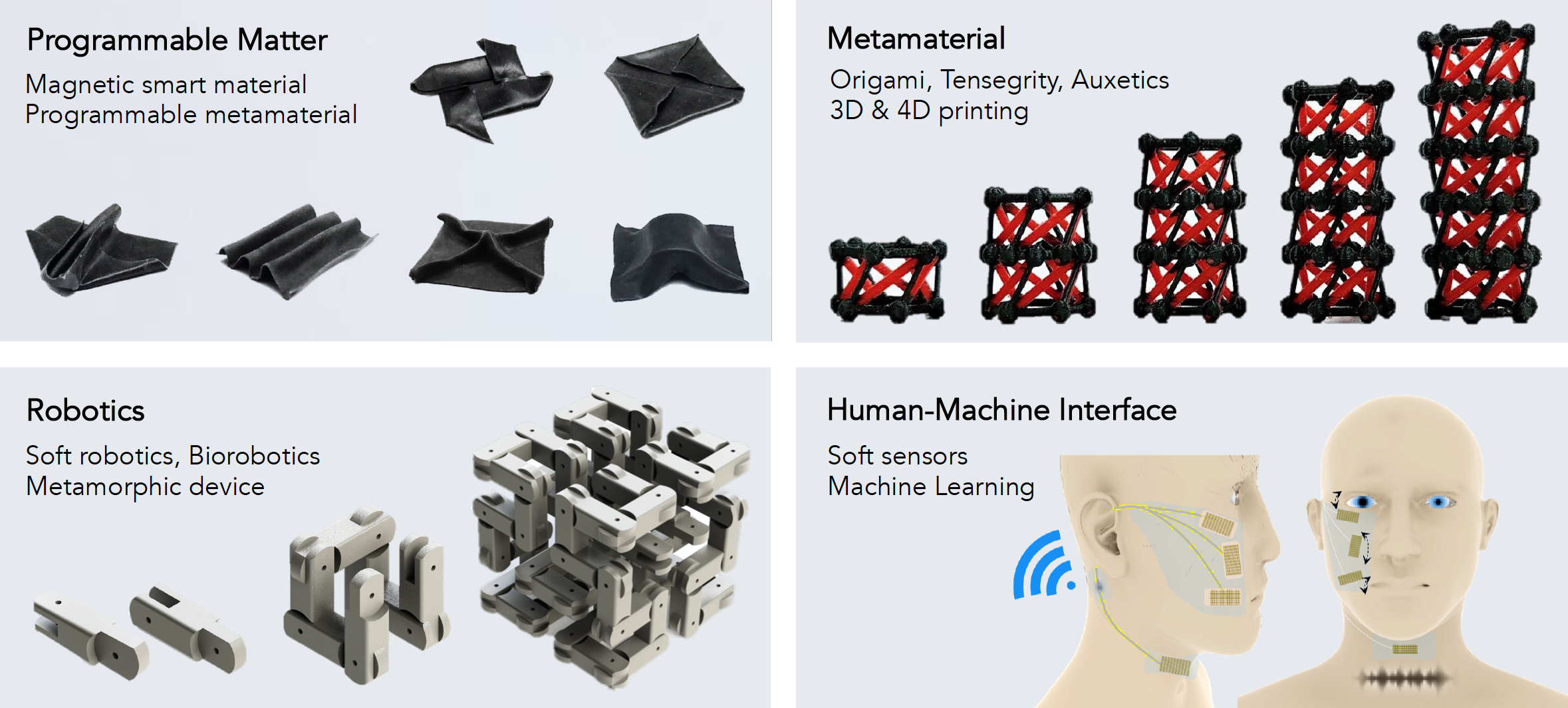
A robot is a machine capable of carrying out a complex series of actions automatically, mimicking forms and functions of specific living organisms, such as human, cheetah, octopus, etc. Beyond mimicking, if we are able to directly program the morphology, body properties and transformation of a robot body, the boundary between virtual and real world will be dramatically blurred. Therefore, we aim to develop universal matters or objects that anyone can program its forms, roperties and sequential motions for specific tasks. This robotic matter in which our lab is interested is a universal platform capable of programming its morphological and material properties by pixelated unit control of body through computing. In this paradigm of robotics, challenges require the innovation in all levels of system including materials, components, architecture to integrate them, manufacturing process and operation. In that respect, we study about programmable matter, smart materials, metamaterial structures, soft robotics, human-machine interfaces, etc.
A robot is a machine capable of carrying out a complex series of actions automatically, mimicking forms and functions of specific living organisms, such as human, cheetah, octopus, etc. Beyond mimicking, if we are able to directly program the morphology, body properties and transformation of a robot body, the boundary between virtual and real world will be dramatically blurred. Therefore, we aim to develop universal matters or objects that anyone can program its forms, roperties and sequential motions for specific tasks. This robotic matter in which our lab is interested is a universal platform capable of programming its morphological and material properties by pixelated unit control of body through computing. In this paradigm of robotics, challenges require the innovation in all levels of system including materials, components, architecture to integrate them, manufacturing process and operation. In that respect, we study about programmable matter, smart materials, metamaterial structures, soft robotics, human-machine interfaces, etc.
연구분야
프로그래머블매터, 로봇공학, 4D프린팅, 메타물질 / Programmable matter, Robotics, 4D Printing, Metamaterial
Programmable matter, Robotics, 4D Printing, Metamaterial
연구 희망분야
인간-기계 인터페이스, 로봇공학, 기계 학습 / Human-machine Interface, Robotics, Machine learning
Human-machine Interface, Robotics, Machine learning
연구주제
Programmable Matter, Smart Materials, Metamaterial, Origami, Tensegrity, Auxetics, 3D printing, 4D printing, Soft robotics, Hybrid robotics, Sensors, Human-machine Interfaces, etc.
Programmable Matter, Smart Materials, Metamaterial, Origami, Tensegrity, Auxetics, 3D printing, 4D printing, Soft robotics, Hybrid robotics, Sensors, Human-machine Interfaces, etc.
국가연구개발사업 기술 분류체계
국가과학기술표준분류
EB. 재료 > EB99. 기타 재료 > EB9999. 달리 분류되지 않는 재료
논문
• SCIENCE ADVANCES / Direct 2D-to-3D transformation of pen drawings / Song, Seowoo; Lee, Sumin; Choe, Jun Kyu; Kim, Na-Hyang; Kang, Junwon; Lee, Amos; Choi, Yeongjae; Choi, Ahyoun; Jeong, Yunjin; Kim, Ju-Young; Kown, Sunghoon*; Kim, Jiyun*/ 2021, Accepted
• SCIENCE ROBOTICS / 3D-printed programmable tensegrity for soft robotics / Lee, Hajun; Jang, Yeonwoo; Choe, Jun Kyu; Lee, Suwoo; Song, Hyeonseo; Lee, Jin Pyo; Lone, Nasreena; Kim, Jiyun* / 2020-08
• NANO LETTERS / Reprogrammable ferromagnetic domains for reconfigurable soft magnetic actuators / Song, Hyeonseo; Lee, Hajun; Lee, Jaebyeong; Choe, Jun Kyu; Lee, Suwoo; Yi, Jee Yoon; Park, Sunghoon; Yoo, Jung-Woo; Kwon, Min Sang*; Kim, Jiyun* / 2020-06
특허
• [국내] Shape Variable Composite and Manufacturing Method / Jiyun Kim, Jee Yoon Yi, Jun Kyu Choe, Yeonwoo Jang, Hyeonseo Song / 2020-08, Registered
• [국내] Tensegrity Structure Composite Material and the Manufacturing Method / Jiyun Kim, Hajun Lee, Hyeonseo Song, Suwoo Lee, Jun Kyu Choe / 2019-11, Applied