

Faculty Research Profile

Min-Suk Kwon


학력
2005: Ph.D. in Electrical Engineering, KAIST
2000: M. S. in Electrical Engineering, KAIST
1998: B. S. (Summa Cum Laude) in Electrical Engineering, KAIST
주요 경력
2014~Present: Associate Professor, UNIST
2012~2014: Assistant Professor, UNIST
2009~2011: Assistant Professor, Sejong U.
2007~2009: Full-time Lecturer, Sejong U.
2006~2007: Senior Research Engineer, LG Electronics Institute of Technology
2005~2006: Postdoctoral Research Associate, USC
수상/학회/외부활동
2019: Best Paper Award, COOC 2019
2018: Best Paper Award, COOC 2018
2017: Best Paper Award, COOC 2017
2014: Best Paper Award, COOC 2014
2013: Best Paper Award, COOC 2013
2010: Best Paper Award, Photonics Conference 2010
2005: Honor Prize at the 11the Samsung Human Tech Thesis
2004: Bronze Prize at the 10the Samsung Human Tech Thesis
2000~2003: Scholarship, Korea Foundation for Advanced Studies (KFAS)
UP 랩
Ubiquitous Photonics Lab
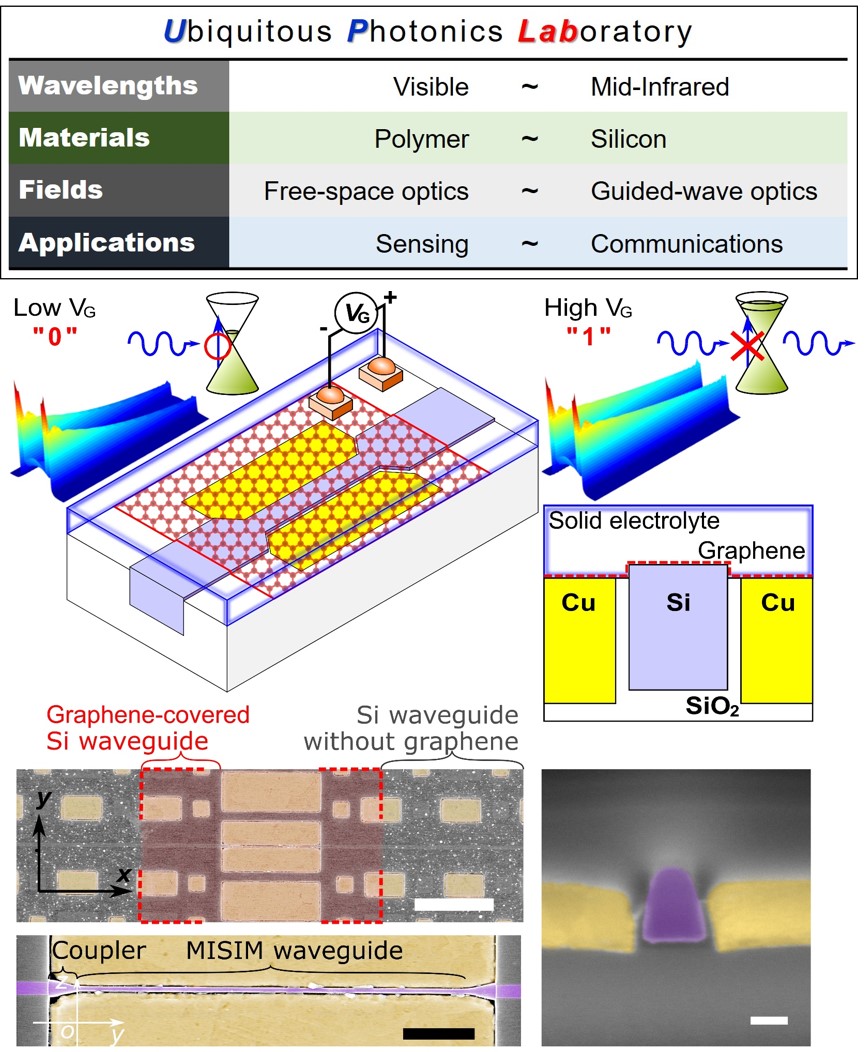
포토닉스는 현재 우리 주변의 다양한 분야에서 사용되고 있는 기술일 뿐만 아니라 미래의 핵심 기술로 판단되고 있다. 본 연구실은 포토닉스의 여러 분야 중 광 도파로를 기반으로 하는 광 집적회로 개발에 집중하고 있다. 특히 실리콘 기반의 포토닉 집적회로와 금속과 실리콘 기반의 플라즈모닉 집적회로 개발을 진행해오고 있다. 이와 더불어 그래핀 기반의 광소자 개발과 다양한 광 센서 개발도 함께 진행하고 있다.
Nowadays liquid crystal displays, light emitting diodes, and optical communications, which are representative examples of photonics, are closely related to everyday life. Thus photonics seems to be ubiquitous or omnipresent. Moreover, it is believed to be essential in developing future technologies such as photonics-aided electronics, quantum computing, extremely sensitive detection of a single molecule, etc. The goal of UP Lab is not only to play a leading role in developing the future technologies but also to make disruptive improvements in the current technologies. We focus on design, realization, and analysis of photonic and plasmonic waveguide devices working at the telecom wavelengths, optical bio/chemical sensors, and mid-infrared devices handling free-space beams.
Nowadays liquid crystal displays, light emitting diodes, and optical communications, which are representative examples of photonics, are closely related to everyday life. Thus photonics seems to be ubiquitous or omnipresent. Moreover, it is believed to be essential in developing future technologies such as photonics-aided electronics, quantum computing, extremely sensitive detection of a single molecule, etc. The goal of UP Lab is not only to play a leading role in developing the future technologies but also to make disruptive improvements in the current technologies. We focus on design, realization, and analysis of photonic and plasmonic waveguide devices working at the telecom wavelengths, optical bio/chemical sensors, and mid-infrared devices handling free-space beams.
연구분야
Integrated-optics, silicon photonics, plasmonics, mid-infrared photonics, graphene photonics
Integrated-optics, silicon photonics, plasmonics, mid-infrared photonics, graphene photonics
연구 희망분야
Photonic integrated-circuits for neuromorphic computing and quantum computing, photonic devices based on two-dimensional materials
Photonic integrated-circuits for neuromorphic computing and quantum computing, photonic devices based on two-dimensional materials
연구주제
[Keywords]
Photonics, Plasmonics, Waveguides, Photonic integrated-circuits, Graphene
[Topics]
Graphene-based silicon photonic modulators and photodetectors
Mid-infrared photonic devices using functional materials
Photonic integrated-circuits based on thin-film lithium niobate
Photonic devices based on ultra-thin metal films
[Keywords]
Photonics, Plasmonics, Waveguides, Photonic integrated-circuits, Graphene
[Topics]
Graphene-based silicon photonic modulators and photodetectors
Mid-infrared photonic devices using functional materials
Photonic integrated-circuits based on thin-film lithium niobate
Photonic devices based on ultra-thin metal films
국가연구개발사업 기술 분류체계
국가과학기술표준분류
ED. 전기/전자 > ED01. 광응용기술 > ED0108. 광소자
논문
IEEE Access, Solid-electrolyte-gated graphene-covered metal-insulator-silicon-insulator-metal waveguide with a remarkably large modulation depth, Yonghan Kim and Min-Suk Kwon*, 2019.
IEEE Photonics Journal, Discussion of the epsilon-near-zero effect of graphene in a horizontal slot waveguide, Min-Suk Kwon, 2014.
Optics Express, Characterizations of realized metal-insulator-silicon-insulator-metal waveguides and nanochannel fabrication via insulator removal, Min-Suk Kwon*, Jin-Soo Shin, Sang-Yung Shin, and Wan-Gyu Lee, 2012.