

Faculty Research Profile
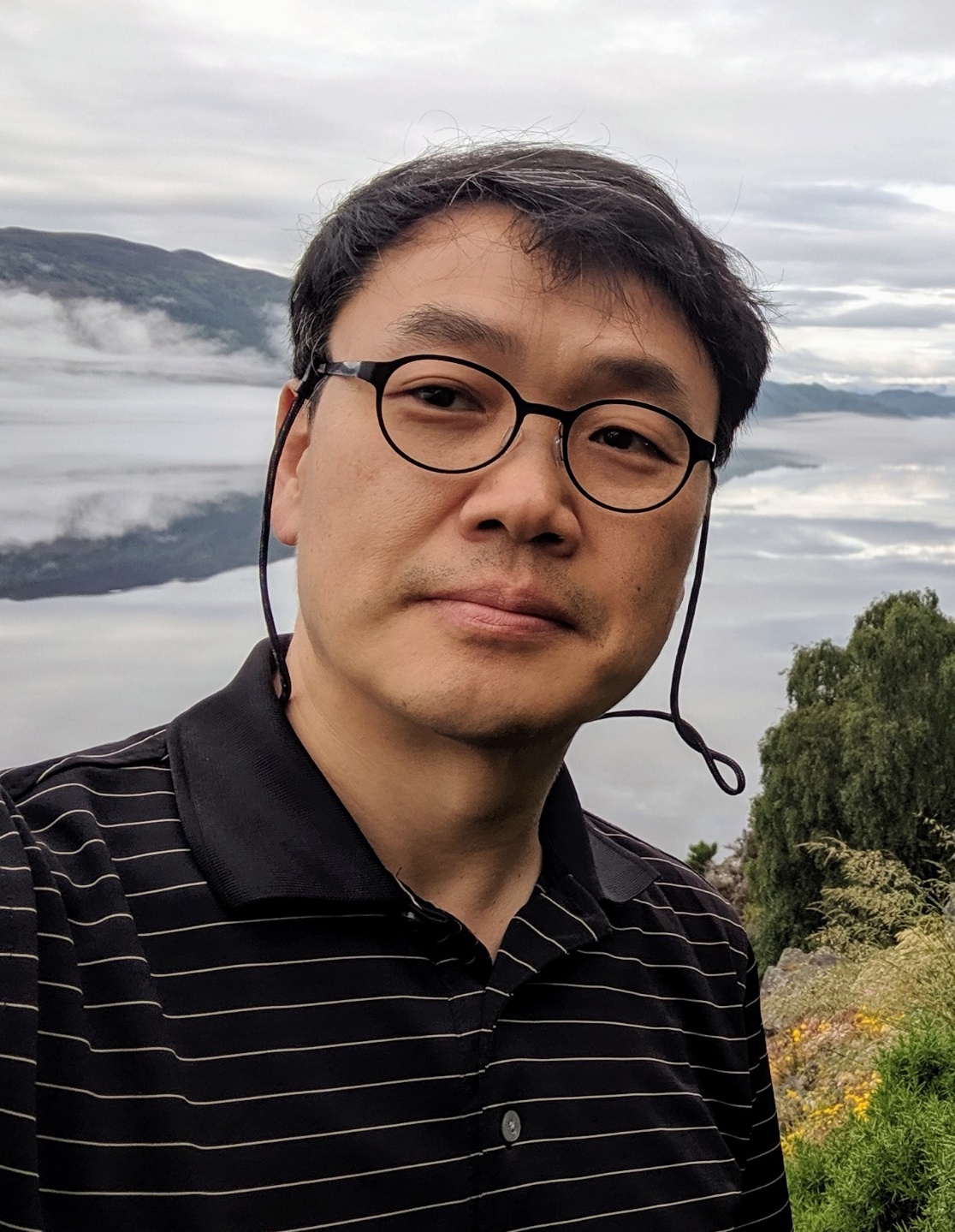
Cheol-Min Ghim


학력
2020 - Present: Program Coordinator, Asia-Pacific Center for Theoretical Physics
2016 - 2019: Director, KIAS-APCTP Statistical Physics Winter School
2003: Ph.D. Physics, Seoul Nat’l Univ
1994: B.S. Physics, Seoul Nat’l Univ
주요 경력
2009 - Present : Associate and Assistant Professor, UNIST
2006 - 2009 : Postdoc, Lawrence Livermore National Laboratory
2006 : Postdoc, Levich institute for Physicochemical Hydrodynamics, City College of New York
2004 - 2005 : Postdoc, Center for Theoretical Biological Physics, University of California, San Diego
2003 - 2004 : Postdoc, Center for Theoretical Physics, Seoul National University
수상/학회/외부활동
Nonequilibrium Statistical Mechanics Based on Active Matter (NRF Korea)
Global Research Center for Organ Mimetics (GRDC, NRF Korea)
Pathogen Predators Program (DARPA, USA)
Time-Reversal Reconstruction of Epidemic Dynamics via Viral Sequence Data (NRF Korea)
Cell-to-Cell Communications in Cancer (SRC, NRF Korea)
이론생물물리연구실
Physical Biology Biological Physics
본 연구실에서는 분자 수준의 세포 내 동역학에서 생태계와 진화에 이르기까지 다양한 시공간 스케일에 걸쳐 일어나는 정보의 전파·확산 및 물질·에너지 대사를 복잡계 이론과 제어의 관점에서 이해하고자 합니다. 이에 수반되는 평형·비평형 통계역학의 문제들은 그 자체로 물리과학적 인식의 지평을 이루는 지식의 최전선이며 동시에 생물학이나 정보과학과의 협업을 기반으로 하는 학제적 연구에도 큰 영감을 줍니다. 이와 같은 문제의식을 바탕으로 본 연구그룹은 생물학적 복잡계의 제어와 설계를 위한 공학적 원리의 확립에도 노력을 기울이고 있습니다.
The Ghim Lab seeks to find the “design” principles behind the networks of biological information processing. The networks encompass cellular metabolism, regulation of gene expression, cell-to-cell communication, and up to social and ecological interactions among individuals. The current focus of research is on:
• Control and exploitation of noise in gene expression
• Resource allocation for coordinated metabolism
• Causal inference in epidemic dynamics and ecological systems
• Game theory in structured populations and reinforcement learning
The aim from biology side is to rationalize the efficiency and robustness of biological networks in the light of form-function duality. The other side of the coin is an effort to restore the precision and accuracy of biochemical information processing in e.g. synthetic biology or metabolic engineering up to its silicon-based counterpart. Both of these objectives are closely linked to the fundamental problems of equilibrium and nonequilibrium statistical mechanics on complex networks. Information theory and statistical physics are a major tool toward this end but the crux is still the rigorous biological realism.
The Ghim Lab seeks to find the “design” principles behind the networks of biological information processing. The networks encompass cellular metabolism, regulation of gene expression, cell-to-cell communication, and up to social and ecological interactions among individuals. The current focus of research is on:
• Control and exploitation of noise in gene expression
• Resource allocation for coordinated metabolism
• Causal inference in epidemic dynamics and ecological systems
• Game theory in structured populations and reinforcement learning
The aim from biology side is to rationalize the efficiency and robustness of biological networks in the light of form-function duality. The other side of the coin is an effort to restore the precision and accuracy of biochemical information processing in e.g. synthetic biology or metabolic engineering up to its silicon-based counterpart. Both of these objectives are closely linked to the fundamental problems of equilibrium and nonequilibrium statistical mechanics on complex networks. Information theory and statistical physics are a major tool toward this end but the crux is still the rigorous biological realism.
연구분야
생물학적 정보처리, 복잡계네트워크, 마이크로바이옴, 능동연성물질계의 비평형통계물리
Biological information processing, Complex networks, Microbiome, Nonequilibrium statistical physics of active soft matter
연구 희망분야
게임이론을 위한 강화학습, 인과적 추론 / Active matter, Causal inference
Active matter, Causal inference
연구주제
<br>Keywords<br />
Control of complex networks, Nonequilibrium statistical physics, Stochastic cell biology, Biochemical information processing, Human microbiome, Ecological inference, Reinforcement learning
<br>Topics<br />
Stochastic thermodynamics of active matter systems
Noise propagation in cellular biochemistry
Control aspects of human microbiome
Reinforcement learning for agent-based ecological models
<br>Keywords<br />
Control of complex networks, Nonequilibrium statistical physics, Stochastic cell biology, Biochemical information processing, Human microbiome, Ecological inference, Reinforcement learning
<br>Topics<br />
Stochastic thermodynamics of active matter systems
Noise propagation in cellular biochemistry
Control aspects of human microbiome
Reinforcement learning for agent-based ecological models
국가연구개발사업 기술 분류체계
국가과학기술표준분류
NB. 물리학 > NB02. 통계물리 > NB0204. 복잡계
논문
•R. Lim, J. Chae, D. E. Somers, C.-M. Ghim, P.-J. Kim, Cost-effective circadian mechanism: rhythmic degradation of circadian proteins spontaneously emerges without rhythmic post-translational regulation, iScience (2021)
•Lim R, Cabatbat JJT, Martin TLP, Kim H, Kim S, Sung J, Ghim CM, Kim PJ, Large-scale metabolic interaction network of the mouse and human gut microbiota, Sci. Data (2020)
•Im H, Son S, Mitchell RJ, Ghim CM, Serum albumin and osmolality inhibit Bdellovibrio bacteriovorus predation in human serum, Sci. Rep. (2017)
•C.-M. Ghim, E. Almaas, Two-component genetic switch as a synthetic module with tunable stability, Phys. Rev. Lett. 103, 028101 (2009)
•Im H, Kim D, Ghim CM, Mitchell RJ, Shedding Light on Microbial Predator-Prey Population Dynamics Using a Quantitative Bioluminescence Assay. Microb. Ecol. (2014)
•Ghim CM, Almaas E, Two-Component Genetic Switch as a Synthetic Module with Tunable Stability. Phys. Rev. Lett. (2009)
특허
•발광성 측정을 이용한 피포식균주-포식균주의 관계 예측방법 / 김철민, 로버트 미첼, 임한솔 (2016)