

Faculty Research Profile

Jae Hwa Lee


학력
· 2012: Ph.D. in Mechanical Engineering, KAIST, South Korea
· 2008: M.S. in Mechanical Engineering, KAIST, South Korea
· 2006: B.S. in Mechanical Engineering, Pusan National University, South Korea
주요 경력
· 2014~Present: Assistant/Associate/Full Professor, UNIST, South Korea
· 2021~2022: Visiting Scholar, UCLA, USA
· 2012~2014: Post-doctoral Researcher, School for Engineering of Matter, Transport and Energy, Arizona State University, Tempe, AZ, USA
· 2012: Post-doctoral Researcher, in Mechanical Engineering, KAIST, South Korea
수상/학회/외부활동
· 2019, Best Paper Award, Annual Meeting of Korean Soc. Comput. Fluids Eng. (KSCFE), Korea
· 2019, Best Paper Award, Annual Meeting of Korean Soc. Mech. Eng. (KSME), Korea
· 2018, Best Paper Award, Annual Meeting of Korean Soc. Comput. Fluids Eng. (KSCFE), Korea
· 2018, Best Paper Award, The 10th National Congress on Fluids Eng. (NCFE), Korea
· 2018, Best Paper Award, Annual Meeting of Korean Soc. Mech. Eng. (KSME), Korea
· 2017, Best Paper Award, Annual Meeting of Korean Soc.
유동 물리 및 제어 연구실
Flow Physics and Control Lab
산업에서 사용되는 총 에너지의 약 25% 는 공기나 물을 통한 운송체의 이동 또는 파이프와 운하를 따라 흐르는 유체를 통해 소비되는 것으로 알려져 있으며, 유체는 물질 및 에너지의 운송, 분리 및 변환이 발생하는 프로세스 캐리어 또는 재료가 될 수 있습니다. 따라서 흐름에 대한 이해는 유체역학 및 이의 응용 분야에서 기술적으로 매우 중요하다고 할 수 있습니다.
이러한 측면에서 본 연구실은 기초에서 응용 공학에 이르기까지 흐름을 이해하고 예측하고 제어하기 위한 연구를 수행하고 있습니다. 이를 위해 수치 해석과 실험 측정(또는 유동 가시화)를 활용하고 있으며, 큰 분류로서 난류 유동, 유체-고체 상호작용 문제, 그리고 다상유동 연구를 통해 최종적으로 고효율 에너지 생산(또는 절약) 시스템을 개발하는데 연구 목표를 두고 있습니다.
About 25% of the total energy used in industry is known to spend in moving vehicles through air or water, or fluids along pipes and canals, and fluids can be a process carrier or material through which transport, separation and conversion processes occur. Thus, understanding of flows is of huge technological importance in aerodynamic and hydrodynamic applications.
In this aspect, we perform research on topics of energetic flows both ranging from fundamental to applied engineering to understanding, predicting and controlling flows. The research includes studies of turbulent flows with physical modeling, fluid-structure interaction problems and multi-phase flows with computational modeling, aiming at development of high-efficient energy-generating(or-saving) systems based on numerical simulations and experimental measurement(or visualization).
About 25% of the total energy used in industry is known to spend in moving vehicles through air or water, or fluids along pipes and canals, and fluids can be a process carrier or material through which transport, separation and conversion processes occur. Thus, understanding of flows is of huge technological importance in aerodynamic and hydrodynamic applications.
In this aspect, we perform research on topics of energetic flows both ranging from fundamental to applied engineering to understanding, predicting and controlling flows. The research includes studies of turbulent flows with physical modeling, fluid-structure interaction problems and multi-phase flows with computational modeling, aiming at development of high-efficient energy-generating(or-saving) systems based on numerical simulations and experimental measurement(or visualization).
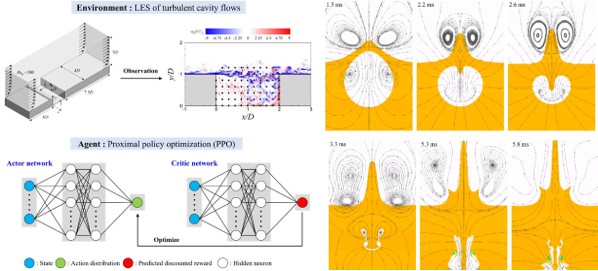
연구분야
난류, 다상유동, 유동 구조 상호 작용, 수치기법개발 / Turbulence, Multi-phase flow, Flow-structure interaction, Numerical Method
Turbulence, Multi-phase flow, Flow-structure interaction, Numerical Method
연구 희망분야
AI 기반 유체 역학, 압축성 유동, 상 변화를 동반한 다상유동 / AI-based Fluid Mechanics, Compressible Flow, Multi-Phase Flow with Phase Change
AI-based Fluid Mechanics, Compressible Flow, Multi-Phase Flow with Phase Change
연구주제
Turbulence, Flow Control for Drag Reduction and Flow-Induced Noise and Vibration
Numerical Simulations and Methods: DNS, LES, Two-Phase Flow, Immersed Boundary Method, Parallel Computing
Incompressible and Compressible Flows
Fluid-Structure Interaction Problem
Multi-Phase Flow with Phase Change
Turbulence, Flow Control for Drag Reduction and Flow-Induced Noise and Vibration
Numerical Simulations and Methods: DNS, LES, Two-Phase Flow, Immersed Boundary Method, Parallel Computing
Incompressible and Compressible Flows
Fluid-Structure Interaction Problem
Multi-Phase Flow with Phase Change
국가연구개발사업 기술 분류체계
국가과학기술표준분류
EA. 기계 > EA07. 에너지·환경기계시스템 > EA0799. 달리 분류되지 않는 에너지/환경기계시스템
논문
· Journal of Fluid Mechanics / Flow-mediated interactions between two self-propelled flexible fins near sidewalls / Jeong, Young Dal; Lee, Jae Hwa, Park, Sung Goon / 2021-03
· Computers & Fluids / A modified monotonicity-preserving high-order scheme with application to computation of multi-phase flows / Ha, Cong-Tu; Lee, Jae Hwa / 2020-01
· Journal of Fluid Mechanics / Space-time formation of very-large-scale motions in turbulent pipe flow / Lee, Jae Hwa; Sung, Hyung Jin; Adrian, Ronald J. / 2019-12
· Physics OF Fluids / Wake transitions of flexible foils in a viscous uniform flow / Kim, Min Je; Lee, Jae Hwa / 2019-11