

Faculty Research Profile
Dongsu Ryu


학력
1988: Ph. D. Astronomy, University of Texas at Austin, USA
1985: M. A. Astronomy, University of Texas at Austin, USA
1983: B.S. Astronomy, Seoul National University, Korea
주요 경력
2023~present: Endowed Chair Professor, UNIST, Korea
2014~present: Professor of Physics, UNIST, Korea
2016~2022: Director of Center for High-Energy Astrophysics, UNIST, Korea
2020~2022: Dean of College of Natural Science, UNIST, Korea
2017~2018: Dean of School of Natural Science, UNIST, Korea
2016~2017: Director of Center for Theoretical Astronomy, KASI, Korea
1992~2014: Professor, Chungnam National University (CNU), Korea
1990~1992: Postdoc, Princeton Univ, USA
1988~1990: Postdoc, Fermilab, USA
수상/학회/외부활동
2022: Member of the Korean Academy of Science and Technology
2020~2021: President of Korean Astronomical Society
2016 - 2017: Vice President of Korean Astronomical Society
2014 - 2017: Vice Chair of Division of Plasma Physics, Association of Asia Pacific Physical Society
2012~2019: Member of Executive Committee of High Energy Density Laboratory Astrophysics
2007~2017: Korea Research Foundation (KRF) Endorsed Scholar
1996: Seoam Fellow, Korea
Astrophysics Lab
천체물리연구실
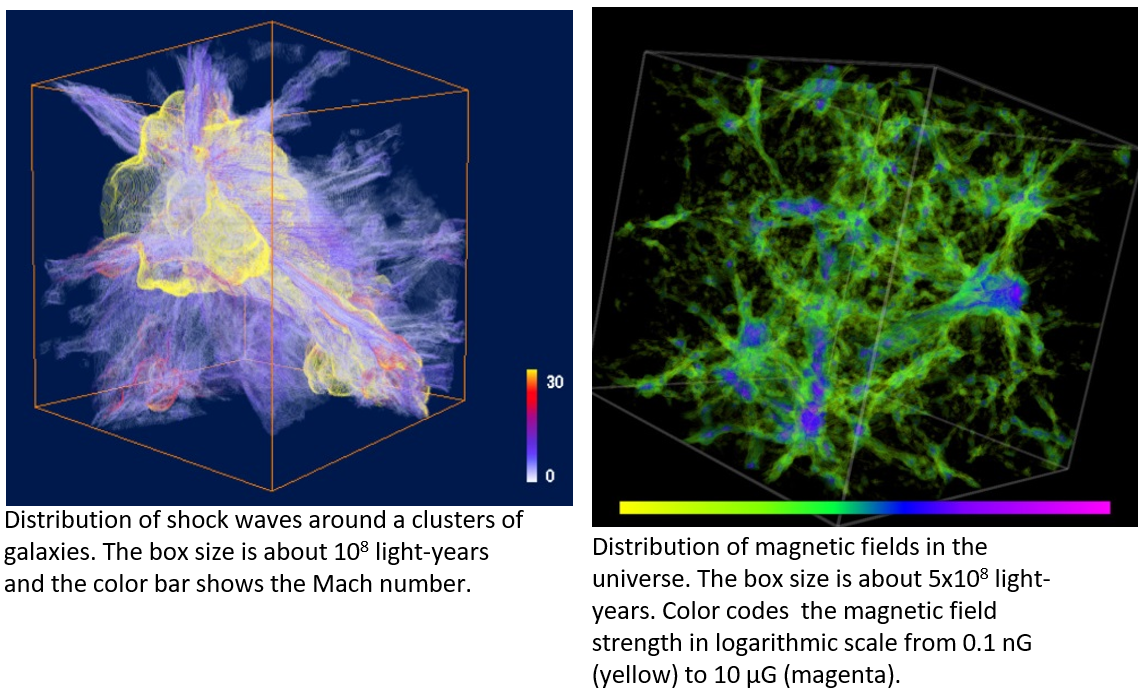
우주는 암흑에너지, 암흑물질과 더불어 바리온(baryon) 물질로 이루어져 있으며, 이들의 물리적 상태는 우주의 진화 역사를 반영하고 있다. 바리온 물질의 대부분은 이온화되어 있으며, 하전 입자들은 자기장(magnetic field)과 결합하여 플라즈마(plasma) 상태에 놓여있다. 이런 우주 플라즈마는 난류운동(turbulent motion)을 하고 있으며, 종종 강력한 충격파(shock waves)가 발생하고, 고에너지 우주선(cosmic rays) 입자를 포함한다. 천체물리 연구실에서는 우주 플라즈마에서 다양한 구성 요소 및 동역학적 과정에 의한 고에너지 천체물리 현상을 연구한다.
The universe contains cosmic plasma of baryonic matter, in addition to dark matter and dark energy. The so-called nonthermal components of the plasma, that is, shock waves, magnetic fields, cosmic rays and turbulence, are expected to play significant roles in the formation and observation of the large-scale structure of the universe. Yet their nature and origin are not fully understood. In the lab, the cosmic plasma as well as dark matter and dark energy are explored. Along with numerical simulations for the formation of the cosmic web, theoretical arguments based on plasma physical models for collisionless shock wave formation, cosmic ray acceleration, astrophysical turbulence, and magnetic field generation are employed.
The universe contains cosmic plasma of baryonic matter, in addition to dark matter and dark energy. The so-called nonthermal components of the plasma, that is, shock waves, magnetic fields, cosmic rays and turbulence, are expected to play significant roles in the formation and observation of the large-scale structure of the universe. Yet their nature and origin are not fully understood. In the lab, the cosmic plasma as well as dark matter and dark energy are explored. Along with numerical simulations for the formation of the cosmic web, theoretical arguments based on plasma physical models for collisionless shock wave formation, cosmic ray acceleration, astrophysical turbulence, and magnetic field generation are employed.
연구분야
High Energy Astrophysics, Plasma Astrophysics, Cosmology
High Energy Astrophysics, Plasma Astrophysics, Cosmology
연구 희망분야
High Energy Astrophysics, Plasma Astrophysics, Cosmology
High Energy Astrophysics, Plasma Astrophysics, Cosmology
연구주제
은하단에서 충격파 및 난류운동
Shock waves and turbulence in clusters of galaxies
우주 자기장 및 고에너지 입자의 기원
Origin and evolution of magnetic fields and cosmic rays in the universe
우주 거대구조에서 플라즈마 천체물리 현상
Plasma astrophysical phenomena in the large-scale structure of the universe
Shock waves and turbulence in clusters of galaxies
Origin and evolution of magnetic fields and cosmic rays in the universe
Plasma astrophysical phenomena in the large-scale structure of the universe
국가연구개발사업 기술 분류체계
국가과학기술표준분류
ND. 지구과학(지구/대기/해양/천문) > ND12. 천문학 > ND1207. 고에너지천문학
논문
Cosmological Shock Waves and Their Role in the Large Scale Structure of the Universe, Ryu, D., Kang, H., Hallman, E. & Jones, T. W. 2003, The Astrophysical Journal, 593, 599 - 610
Turbulence and Magnetic Fields in the Large Scale Structure of the Universe, Ryu, D., Kang, H., Cho, J. & Das, S. 2008, Science, 320, 909 - 912
A Diffusive Shock Acceleration Model for Protons in Weak Quasi-parallel Intracluster Shocks, Ryu, D., Kang, H., & Ha, J.-H. 2019, The Astrophysical Journal, 883, 60 (7pp)